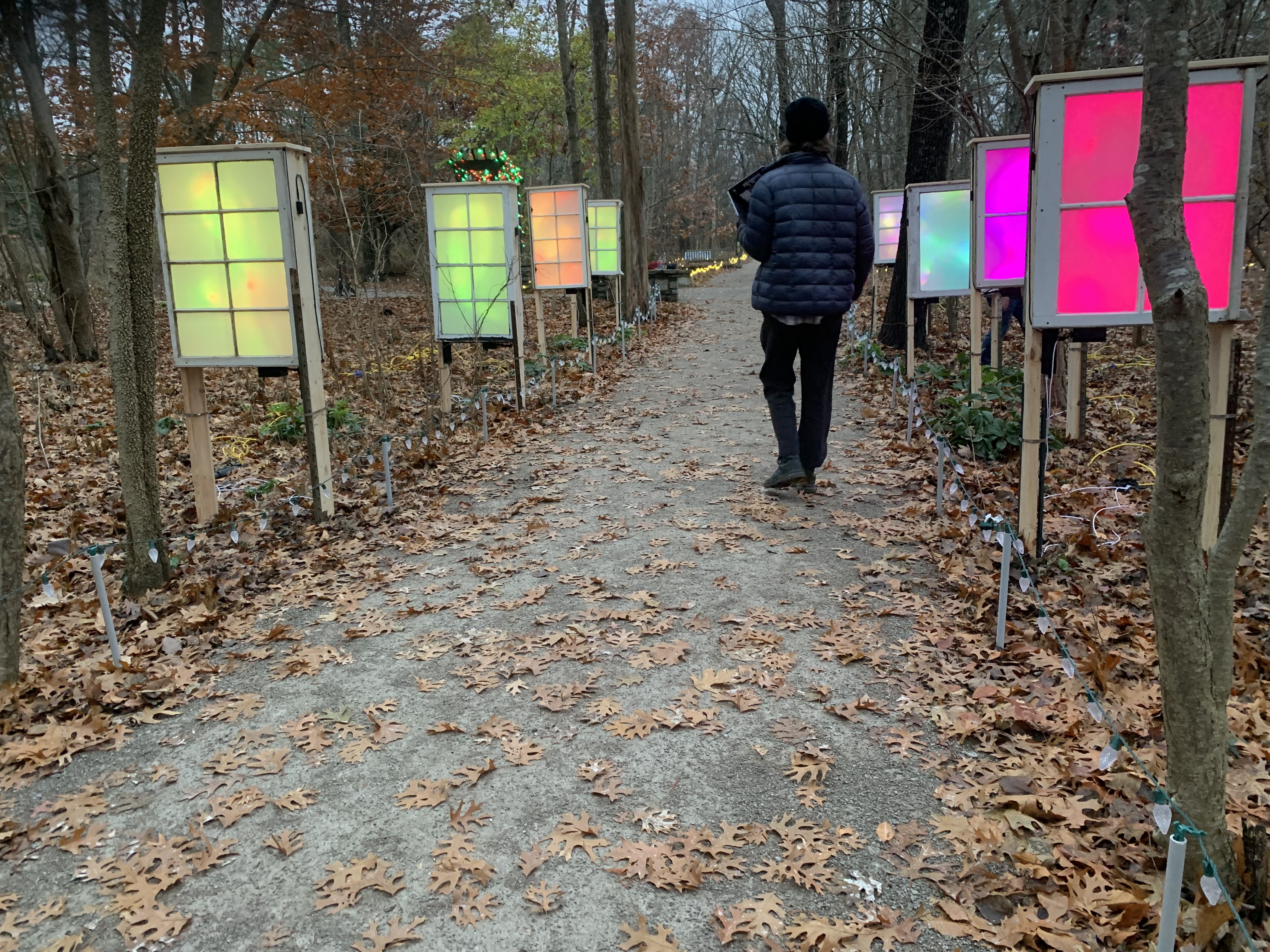
See Light Portals at Cincinnati Nature Center through Dec 28
Light Portals by Greider Lightworks is a father/son collaboration of Herm and Aaron Greider.

Aaron Greider
Graphic Designer/Front-End Web Developer at Jungle Jim’s International Market. BS Communication Design from UC DAAP 2022. Cincinnati Nature Center Member and new volunteer (2025!). Eagle Scout and native plant enthusiast. Bane of honeysuckle.

Herm Greider
Retired Software Developer with 40 years experience leading, designing, and coding all types of software systems for defense and commercial applications. BS Computer Science, UC. MS CS Wright State. Currently prototyping next ideas for Light Portals.
Animating Memories
Do artifacts from the past keep the memories of their users? Our Light Portals are built from reclaimed windows, letting the light of the past shine through and inviting visitors to imagine the homes and families who used these windows.
This collaborative project blends reclaimed windows and technology to create an engaging light and sound experience. Building on their shared interest for technology, environmental art, and interactive installations, Aaron and Herm invite audiences on a journey through light and sound.
Light Portals is installed at Cincinnati Nature Center for Light in the Forest through Dec 28.
How do they work?
The installation is constructed of eight individual wooden frames from reclaimed windows, with programmable multicolor LED strips sealed between two panes and fully waterproofed.
Each LED responds to data from proximity sensors, changing hue, intensity, and pattern to bring the illuminated “forest specters” to life.
A programmable synthesizer creates voices and notes based on visitor movement, fading tracks in and out and shaping waveforms for a more immersive experience. Each portal contains its own speaker to create an immersive sound experience.
Windows and Frames
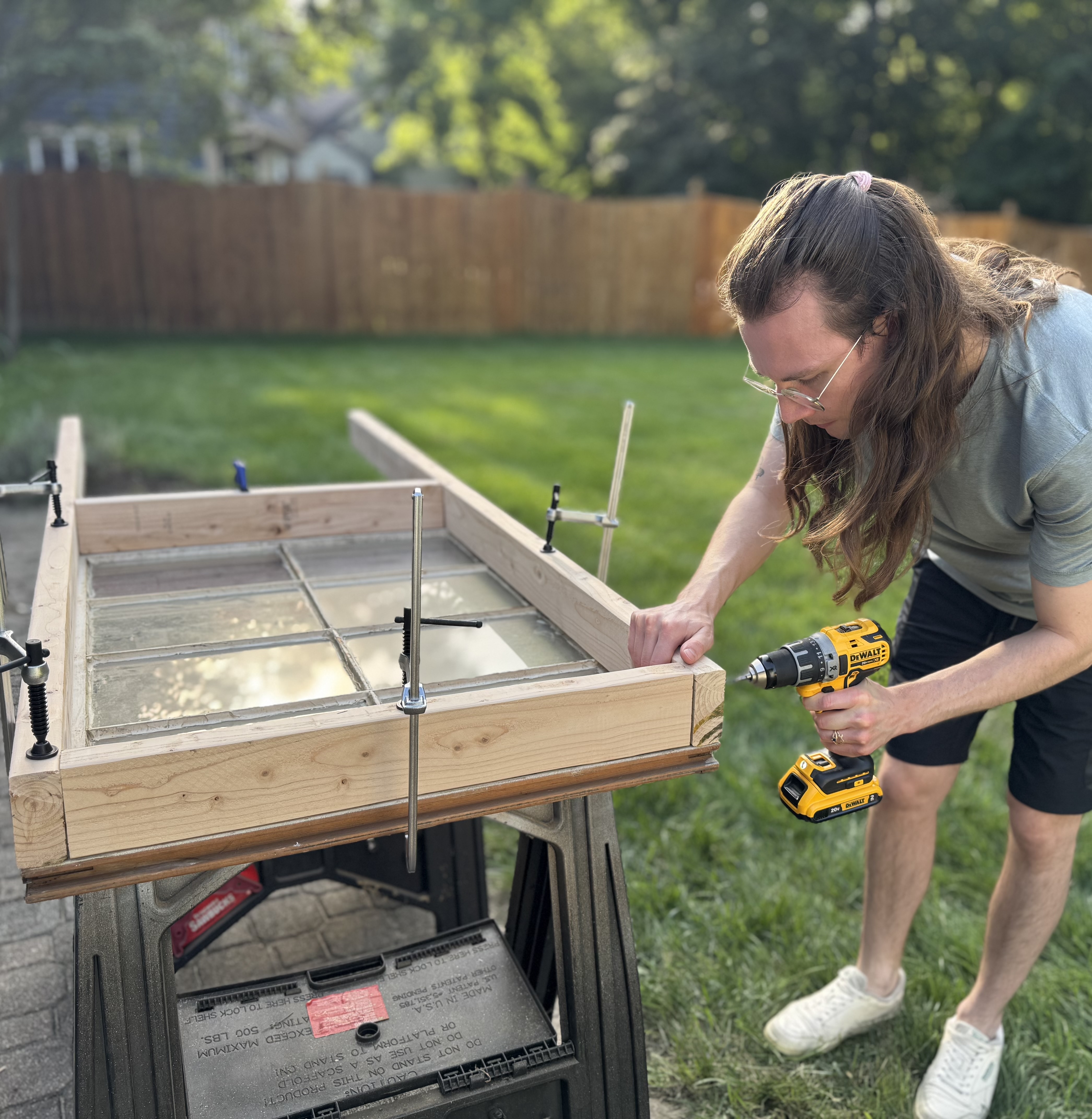
The reclaimed windows are from early to mid-century houses. Windows are mounted into simple 2x6 frames. We replaced glass where necessary and recaulked all the panes to avoid breakage.
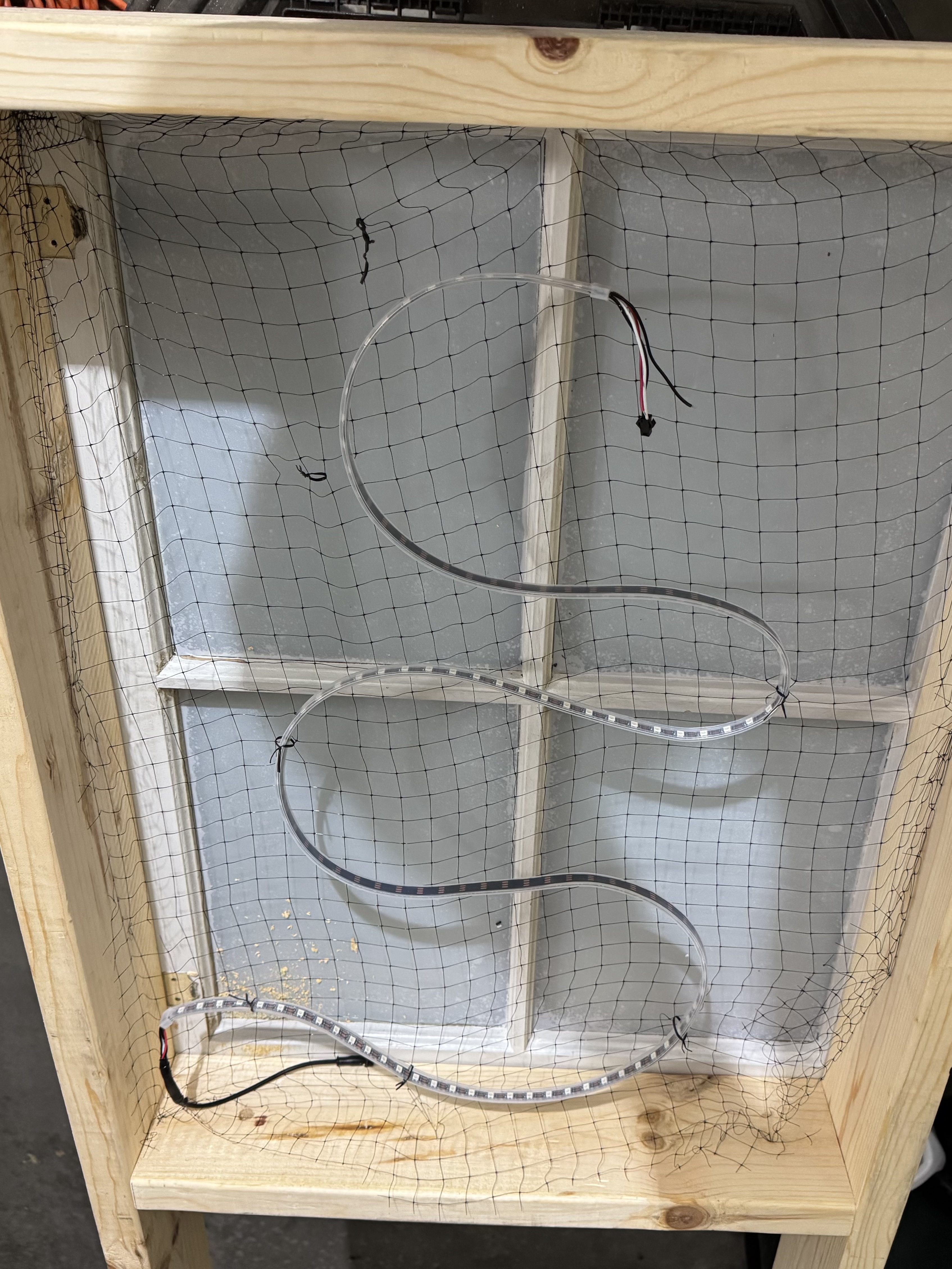
The LEDs are mounted into the windows on simple garden netting stapled to the 2x6 frame. We experimented with LED layouts in the windows based on the arrangement of the panes to create "spectors" in the windows animated with the LEDs.
Weatherproofing was key to the design. We kept the frame build simple and then caulked all seams. The windows have remained watertight even in several inches of snow. This design has also proved to be condensation-free.
To diffuse the LEDs, we used diffusion film squeegeed to each pane with some additional adhesive to ensure the film did not peel or bubble.
LEDs
Each Portal is illuminated by a two-meter Adafruit NeoPixel LED strip, encased in an IP67-rated silicone sleeve. Each strip contains 120 individually addressable RGB LEDs, allowing light to be precisely controlled at every point along its length.
The LED strips are suspended within the frame using garden netting, creating a flexible, non-rigid structure that diffuses the light and softens the geometry of the form.
The LEDs are programmed in MicroPython using a mathematically generated noise algorithm that animates across all 120 pixels. Environmental sensors continuously influence this animation. As visitors approach the Portals, the movement accelerates and the color palette shifts, causing the light to respond directly to human presence and proximity.
Sound
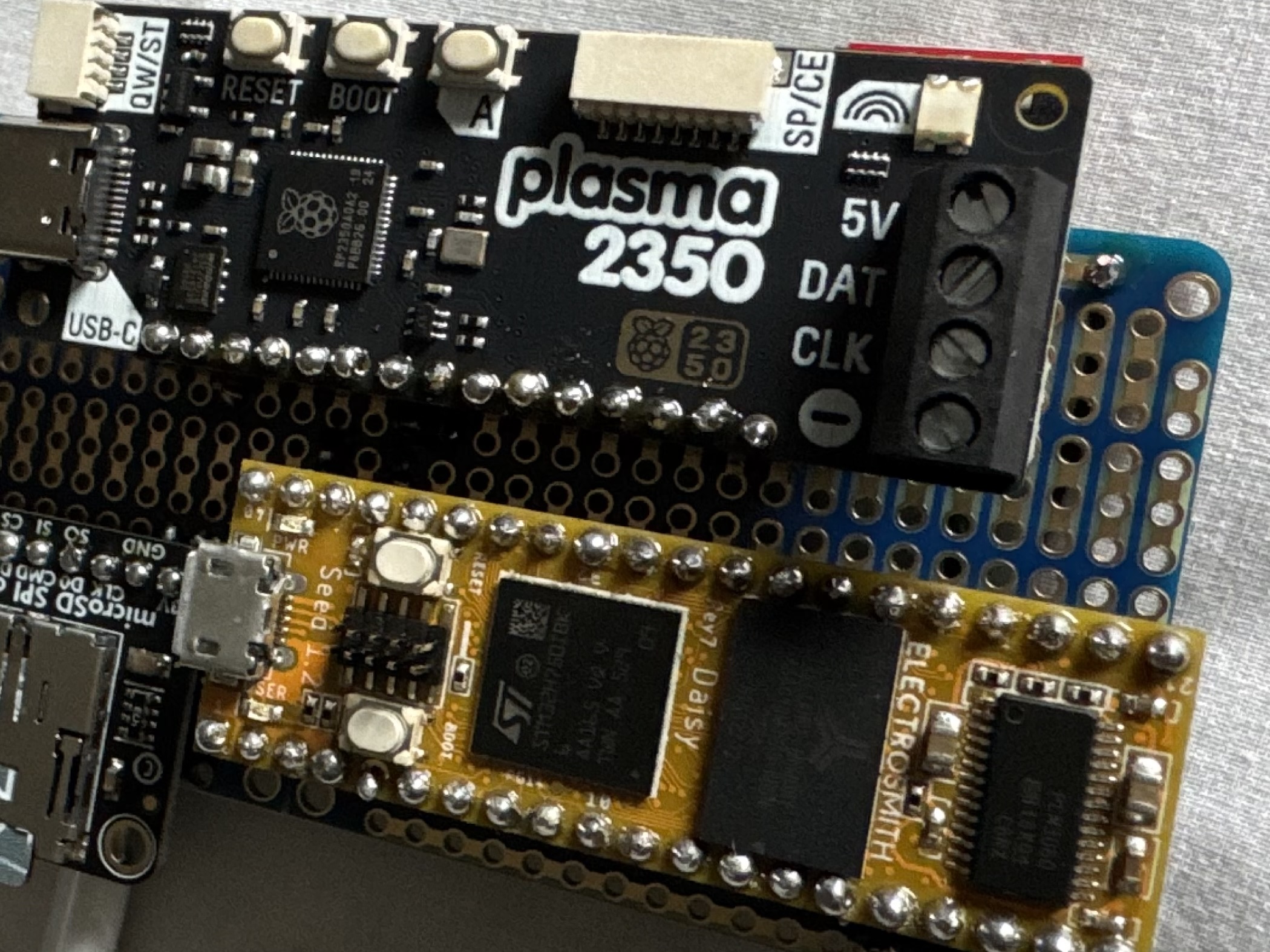
Each Portal generates sound using a Daisy Seed audio board. We built a dedicated sound engine for each Portal, giving every unit its own sonic character.
We developed several custom synthesizers in C++, including a bell-like resonant instrument, a traditional subtractive synthesizer with a Moog-style low-pass filter, and a percussive noise-based shaker. Each Portal runs a single sound engine, selected to shape its role within the larger installation. Configuration data and MIDI data live on an SD card, allowing the sound behavior to evolve over time.
Each Portal contains its own speaker, creating a field of independent sound sources. As visitors move through the space, each Portal responds to proximity by subtly shifting its sound. Because the sound engines are not synchronized, their relationships drift and phase naturally. The result is an immersive listening experience in which the sound changes continuously depending on position, movement, and duration of attention.
Microcontroller
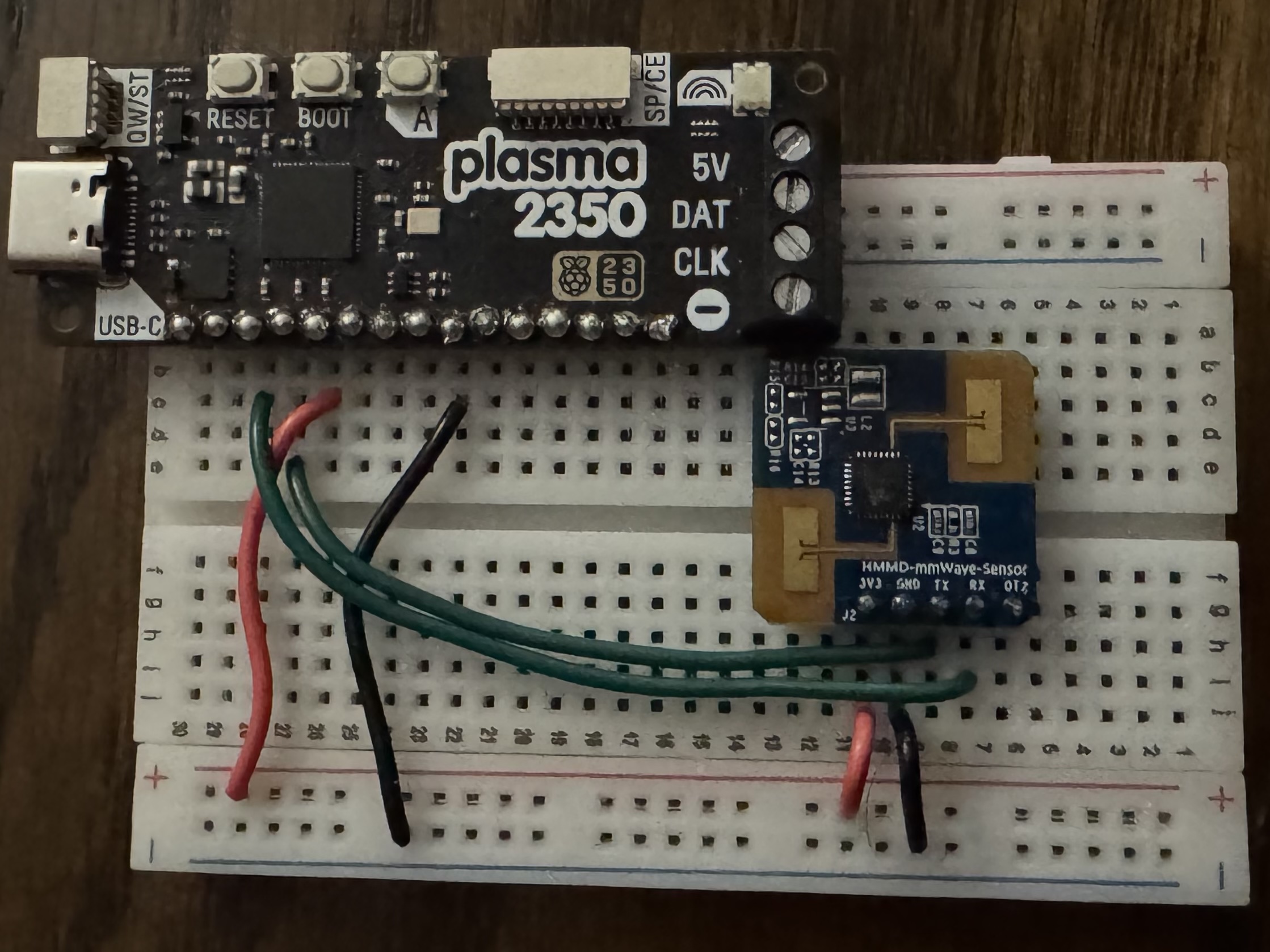
Control is handled by a Pimoroni Plasma 2350 microcontroller. This board was selected for its ability to supply both 5V power for the LED strips and 3.3V power for sensors and control electronics, allowing the system to operate from a single controller without additional power regulation.
A distance sensor is connected to the Plasma 2350 via a serial interface. The measured distance value is used by the microcontroller to influence the LED animations and is also transmitted over a second serial connection to a Daisy Seed audio module. Both light and sound respond to the same proximity data, maintaining a direct relationship between visitor movement and system behavior.
Programming for the Plasma is in MicroPython.
Sensors
We use mmWave radar sensors to detect visitors. Ultrasonic sensors didn’t provide reliable readings for human distance, so we switched to mmWave, which delivers consistent and precise measurements up to five meters.
We mount each sensor along the side of the Portals, giving it a roughly 60-degree field of view to detect movement from both the front and back. As people move through the space, the sensors generate a wave of change that passes through the Portals, synchronizing their light and sound in real time.
Cabling posed a challenge, so we built custom four-foot, four-conductor wires that plug directly into the main board. These allow us to position the sensors cleanly along the Portal frames while keeping the electronics centralized.
Collective Behavior
The Portals operate as an ecosystem of independent elements. Light, sound, and sensing are distributed across the installation rather than centralized, allowing each Portal to respond on its own while remaining connected to the larger field.
As visitors move through the space, their proximity subtly alters color, motion, and sound. No two positions produce the same experience. Light patterns shift, sound sources drift and phase, and relationships between Portals change continuously as people pass through and linger.
The installation does not present a fixed sequence or defined viewpoint. Instead, it unfolds through movement and attention, revealing itself differently with each encounter.